Springwood at Hampstead Theatre: Uninspiring and Repetitive
A Subtle Exploration of Historical Tensions
Traveloasisspot.com – Richard Nelson’s play Springwood offers a muted portrayal of George VI’s 1939 meeting with Franklin Roosevelt at the latter’s presidential estate, framing it as a pivotal yet unremarkable moment in history. The narrative delves into the early stages of the uneasy “special relationship” between the two leaders, which emerged amid the looming specter of global conflict. This period, marked by the United States’ reluctance to intervene in European affairs, contrasts sharply with the British royal family’s internal struggles following the abdication of Edward VIII. His choice to marry Wallis Simpson, an American divorcee with ties to Hitler, left the monarchy in a precarious position, a backdrop Nelson uses to highlight the complexities of diplomacy and personal struggle.
The central figures, both monarch and president, grapple with physical and emotional challenges: the King’s stutter and the President’s polio. Their spouses, too, are depicted as more than just dutiful figures. Eleanor Roosevelt’s exasperation with her husband’s eccentricities and the Queen’s discomfort with her role as a supportive partner are central to the play’s character dynamics. Nelson aims to humanize these leaders by emphasizing their vulnerabilities, yet the resulting tone feels overly subdued, with a rhythm that lags and a script that over-explains.
“Everyone addresses them as ‘your highness’ rather than ‘your majesty’: I don’t know if this is meant as a deliberate, passive-aggressive diss or if it’s just an error of Nelson’s.”
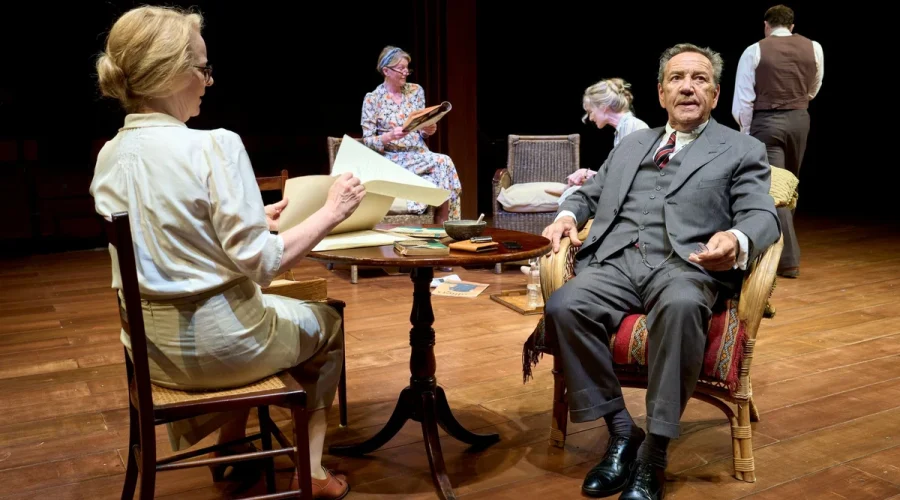
The play’s stage design reinforces this feeling of detachment, featuring a forestage with an expansive void behind it—a visual metaphor for the isolation and uncertainty of the era. While the performances by Robert Lindsay as FDR and Jemma Redgrave as Eleanor are solid and understated, they fail to elevate the narrative beyond its predictable, everyday nature. Even the actors’ physicality, such as Lindsay’s crisp attire or Havill’s youthful portrayal of King George VI, seems at odds with the historical gravitas Nelson seeks to convey.
Directorial Shift and Stage Design
Stanley Tucci, originally set to direct the production, withdrew from the project, leaving Richard Nelson to take the helm. This transition coincided with a noticeable decline in the play’s critical reception, with enthusiasm surrounding the production plummeting by nearly 90%. The new direction emphasizes simplicity, but the result feels more like a dull reiteration of familiar themes than a fresh perspective. The stage setup, while symbolic, adds little to the overall impact, with its stark, open backdrop offering no additional layers to the narrative.
Nelson’s focus on the Roosevelt family’s domestic life introduces a blend of nostalgia and humor. The President’s penchant for casual living—shared with his domineering mother, played by Eileen Nicholas—paints a picture of a family that thrives in a folksy, thin-walled home on the Hudson River, 85 miles north of New York City. This setting, though charming, is juxtaposed with the media’s and public’s indifference to FDR’s physical disabilities and unconventional lifestyle. The play’s attention to these details is commendable, but it risks overshadowing the emotional core of the story.
Royal Dynamics and Historical Nuances
One of the play’s most engaging elements is its portrayal of the Roosevelt household, where the President’s informal demeanor contrasts with his wife’s composed authority. The domestic front is presented as a united effort, with Eleanor’s syndicated newspaper column offering a window into their shared life. Yet, beneath this facade, the couple’s separate worlds are evident: he indulges in cigars, cocktails, and the company of an acknowledged mistress, while she retreats to a nearby cottage, surrounded by two female furniture makers who “like each other.” This subtle nod to their personal lives adds a layer of intrigue, though it’s not enough to counterbalance the play’s overall lack of momentum.
Meanwhile, the King and Queen’s reactions to this informal setup are both humorous and poignant. Their confusion over the Roosevelts’ lifestyle—such as the presence of mocking caricatures on the wall and the absence of breakfast tea—highlights their struggle to adapt to the modern world. The staff’s cynical attitude, evidenced by their placement of magazines open to articles questioning Wallis Simpson’s suitability as a consort, further underscores the tension between tradition and progress.
The script’s reliance on extended dialogue about the symbolism of hot dogs and the political significance of the picnic meal feels excessive. While these moments are intended to add depth, they often serve as filler rather than meaningful commentary. The King’s stammering and the Queen’s petulant demeanor are well-executed, but they are overshadowed by the cast’s age discrepancy. Both Havill and Lindsay appear 20 years younger than their historical counterparts, creating a disconnect that diminishes the authenticity of their portrayals.
Rebecca Night’s performance as Queen Elizabeth, though earnest, seems to highlight the contrast with her husband’s commanding presence. Her character’s bleating tone and childlike vulnerability are evident, especially when juxtaposed with the Roosevelt couple’s dynamic. The play’s insistence on a singular note of weariness for Eleanor’s character, despite her multifaceted relationship with FDR, further contributes to its lack of emotional nuance.
Other Headlines for Context
While Springwood remains the focus, the article also touches on other recent productions at Hampstead Theatre, such as the backstage comedy Stage Kiss, which is described as “amusing but lightweight.” In contrast, the West End’s response to the 36°C heat has sparked discussions about the need for climate-conscious scheduling, with performers expressing discomfort in the sweltering conditions. Meanwhile, Pride’s musical adaptation of a feel-good film is noted for its charm, though its impact is left unexplored in the brief mention.
Despite these additional references, the central critique of Springwood endures: its attempt to bridge the gap between history and human connection feels uneven. The play’s reliance on understated performances and deliberate pacing, while fitting its tone, may leave audiences yearning for more dynamic storytelling. For those seeking a thoughtful exploration of the past, Springwood offers a glimpse, but its humdrum nature suggests it may not be the most compelling choice for a historical drama.