
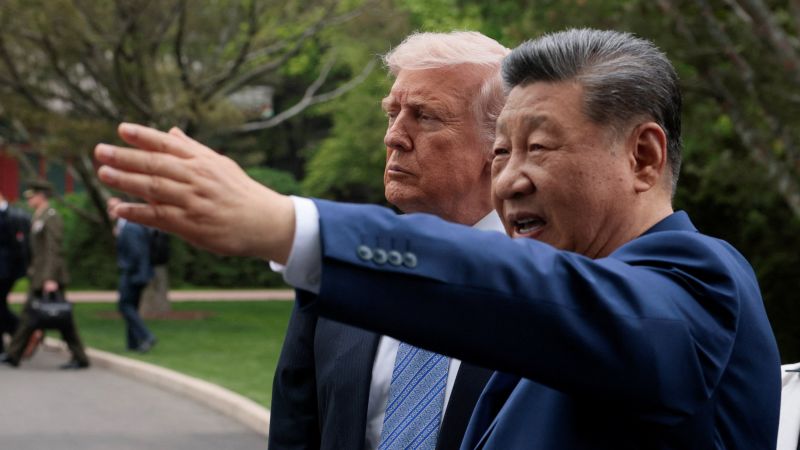
Trump’s Beijing visit was more vibes than details. And Xi set the tone
Trump s Beijing visit was more – President Donald Trump’s recent trip to China may have lacked immediate results on contentious issues like technology and trade, but it marked a pivotal moment in shaping the U.S.-China dynamic. While tangible agreements were sparse, Chinese leader Xi Jinping appears to have viewed the encounter as a major triumph. For Beijing, the outcome was less about concrete outcomes and more about reinforcing its status as a global power on par with the United States. A key focus during the visit was Taiwan, the linchpin of China’s strategic priorities, with Xi ensuring that the U.S. recognized the island as an essential part of its territory. This subtle but deliberate messaging underscored Beijing’s determination to project itself as a dominant force in international relations.
Projecting Power Through Symbolism
China’s approach to the visit was meticulously designed to impress Trump, blending grandeur with calculated diplomacy. From the outset, the nation’s leaders showcased their influence through a military salute and an exclusive tour of Zhongnanhai, the secretive compound housing the Communist Party’s highest decision-makers. These gestures, though symbolic, carried weight in reinforcing China’s geopolitical clout. The state banquet, another highlight of the trip, provided a platform for Xi to align his narrative with Trump’s affirmations, creating a shared vision of a cooperative U.S.-China partnership. The American president, during the event, praised the relationship as one of the “most consequential” in history, a sentiment that resonated with Xi’s own remarks.
“We can create a future of greater prosperity for the world,” Trump declared during the banquet, emphasizing the mutual benefits of the alliance. This aligned with Xi’s toast, which echoed similar optimism about the partnership’s potential.
Despite the lack of binding agreements, the visit’s significance lay in its ability to establish a positive tone. The two leaders spent hours in dialogue, exchanging effusive praise and fostering a sense of camaraderie. This “great-power bonhomie” was evident in their public interactions, where they underscored the importance of collaboration over competition. The result was a framework of “constructive strategic stability,” a term Xi introduced to signal a shift from the volatile rivalry that defined the previous year. This concept, while not immediately binding, offered a vision of managed cooperation, with both sides aiming to avoid escalation in key areas.
The Taiwan Factor: A Red Line in the Relationship
Taiwan emerged as the central theme of the visit, with Xi Jinping using the opportunity to reiterate its strategic importance. During their first day together, the Chinese leader made it clear that any misstep by the U.S. on the issue could jeopardize the broader relationship. “If Washington doesn’t handle this issue well, the entire U.S.-China relationship will be put in great jeopardy,” Xi warned Trump, highlighting the island’s status as a non-negotiable red line. This emphasis reflects China’s long-standing view of Taiwan as an inseparable part of its territory, a perspective that has driven its military and diplomatic efforts for decades.
Trump’s public acknowledgment of Xi’s concerns, including the U.S.’s regular arms sales to Taiwan, signaled his willingness to engage. “We discussed the subject in great detail,” the president told reporters on his return flight, hinting at a decision on Taiwan’s arms procurement in the near future. While the White House’s official summary didn’t explicitly adopt Xi’s phraseology, the conversation suggested a mutual understanding of the importance of stabilizing the relationship. Top diplomat Marco Rubio echoed this sentiment, stating that the U.S. agreed with China’s emphasis on “constructive strategic stability” to prevent misunderstandings from escalating into broader conflict.
“The U.S. agrees with China’s emphasis on this so that we don’t have misunderstandings that can lead to broader conflict,” Rubio remarked, underscoring the diplomatic value of the visit.
Strategic Stability and Global Implications
The concept of “constructive strategic stability” was not just a rhetorical flourish—it was a strategic tool for Beijing to assert its dominance in shaping global dynamics. By framing the U.S.-China relationship as one of cooperation, China aimed to position itself as an alternative to American leadership. This narrative is crucial domestically, where Xi’s government seeks to bolster its legitimacy by presenting a vision of China as a key player on the world stage. Internationally, the emphasis on collaboration aligns with China’s broader goal of challenging the U.S.’s geopolitical influence.
Meanwhile, the visit’s success also allowed Beijing to buy time for its continued ascent in technological, military, and geopolitical spheres. The U.S. has long relied on its economic and technological advantages, but the recent trade war exposed vulnerabilities. China’s control over rare earth elements, for instance, demonstrated its leverage in global supply chains. By tightening its grip on these critical materials, Beijing disrupted U.S. manufacturing and highlighted its capacity to influence international markets. Trump’s visit provided an opportunity to reaffirm this balance, with the American president acknowledging the need for stability in trade and tech discussions.
Future Prospects and the Road Ahead
Looking forward, the visit’s legacy will extend beyond the immediate discussions. Next week, Russian President Vladimir Putin is set to visit China, further solidifying the alliance between the two nations. This pairing of global powers creates a formidable bloc, one that can challenge Western dominance in various regions. For China, the timing of these meetings is significant, as it seeks to project a united front against U.S. influence.
Yet, the path to sustained stability is not without challenges. While the visit emphasized cooperation, the definition of “strategic stability” could grant China the flexibility to contest U.S. actions perceived as antagonistic. This includes the trade war and technological disputes that flared last year. The balance between cooperation and competition remains delicate, and the U.S. must navigate this carefully to avoid triggering a new round of tensions. However, the emotional connection fostered during the visit suggests that both leaders are committed to maintaining a stable partnership, even as they pursue their national interests.
As the dust settles from Trump’s trip, the implications for the global economy become apparent. A stable U.S.-China relationship can drive economic growth, just as its frictions have the potential to disrupt trade. The question now is whether this stability will translate into lasting cooperation or remain a temporary truce. For now, the visit has delivered a strong message: China is not just a rising power, but a confident leader ready to shape the future of international relations. The key to this vision lies in how both nations manage their differences, particularly on Taiwan, where the stakes remain high for the global order.





