
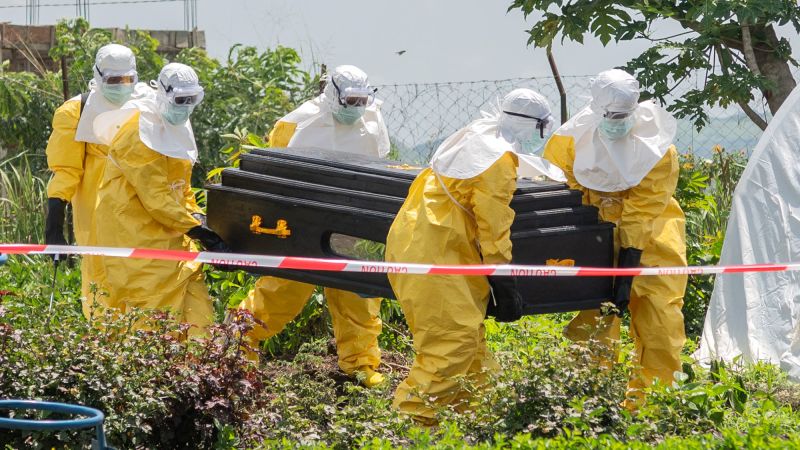
US funding cuts have hampered response to the deadly Ebola crisis, aid workers say
US funding cuts have hampered response – A severe Ebola outbreak is spreading rapidly through northeast Democratic Republic of the Congo (DRC), prompting aid organizations to critique the factors that delayed early intervention. Health workers and officials from international agencies are pointing to a combination of staffing reductions in health programs supported by U.S. funding, shortages of essential medical resources, and a sharp decline in American contributions to global health initiatives. These challenges, they argue, have weakened the capacity to detect and contain the virus swiftly, exacerbating the crisis as it evolves.
WHO warns of underestimated epidemic scale
The World Health Organization (WHO) has raised concerns about the extent of the outbreak, stating that over 170 fatalities are likely connected to this strain of the virus. As of now, more than 750 cases have been reported, with the organization emphasizing that the epidemic’s true size may be significantly larger. This strain, which lacks a specific vaccine or treatment, has been circulating undetected for months before its identification. The delay in detection, according to the WHO, stems from multiple factors, including the unusual nature of the virus, the limited health infrastructure in the rural regions where it first emerged, and ongoing ethnic conflicts that impeded testing efforts.
“We know the scale of the epidemic in DRC is much larger,” said a WHO representative. “This strain of the virus could have been circulating for months before it was detected.”
Experts and aid workers highlight how the Trump administration’s policies have compounded these challenges. The administration’s cuts to foreign aid and its withdrawal from WHO, the global health body responsible for managing outbreaks, have created a ripple effect on international health systems. While the administration attributes the delayed response to other factors, critics argue that the cumulative impact of these decisions has hindered the ability to act swiftly and effectively.
Four-pronged US aid strategy under pressure
The Trump administration’s approach to global health funding has been characterized by four major changes. First, it withdrew financial support from the WHO, reducing its capacity to coordinate responses. Second, it disbanded the U.S. Agency for International Development (USAID), which historically played a key role in funding humanitarian efforts. Third, it cut budgets at the Centers for Disease Control and Prevention (CDC), which has maintained a presence in affected regions for years. Finally, it is actively decreasing aid to the DRC and Uganda, the two countries central to the current outbreak.
“When you add up all of those elements, it’s hard to see how there could not have been an effect on the surveillance and response capacities in these countries,” said Josh Michaud, associate director for global and public health policy at KFF.
These actions have left global health systems vulnerable, according to experts. The International Rescue Committee (IRC), which operates humanitarian programs in the DRC, noted that U.S. funding reductions contributed to the slower identification of the virus. “Weakened disease surveillance systems following severe health funding cuts in eastern DRC are contributing to the rapid escalation of the latest Ebola outbreak,” the IRC stated in a recent release.
“Years of underinvestment and recent funding cuts have left many health facilities without adequate protective equipment, surveillance capacity, or frontline support needed to respond quickly and safely,” added Heather Reoch Kerr, the IRC’s country director for DRC.
A senior State Department official defended the administration’s decisions, asserting that the funding changes did not hinder efforts to address the outbreak. “Once the epidemic was identified, our response was swift,” the official claimed. They argued that the Ebola management programs, along with funding awards, were seamlessly transferred to other agencies after USAID’s dissolution. “There was no specific person or program associated with USAID in this region that would have detected this or contributed to a detection framework here,” the official told reporters.
The CDC’s incident manager for the Ebola response, Dr. Satish Pillai, echoed this sentiment. “Our agency has been working in this area for decades, with 100 staff in Uganda and nearly 30 in the DRC,” he said. Pillai also noted that the CDC has mobilized hundreds of personnel for the emergency response launched this week. However, aid workers remain skeptical, pointing to the timeline of the outbreak as evidence of the impact of US funding cuts.
Timeline of the crisis highlights detection delays
Health officials now report that the first death linked to this outbreak occurred in Ituri Province, northeast Congo, on April 20. Despite this, the outbreak wasn’t officially recognized until May 15, a delay attributed to the lack of local testing capabilities. The Bundibugyo strain, which is less common, required samples to be transported over 1,000 miles to a laboratory in Kinshasa for confirmation. This logistical hurdle, combined with the region’s limited infrastructure, slowed the identification process.
“It’s a little tough to get to it, because it’s in a rural area, so it’s kind of confined in a hard to get to place in a war-torn country,” said US Secretary of State Marco Rubio, who recently criticized the WHO for being “a little late to identify this thing.”
Rubio acknowledged that other challenges, such as ethnic conflicts and weak health systems, played a role in the delay. However, he emphasized that the US government’s actions did not directly impede the response. “We have the capacity to act quickly,” he argued, suggesting that the WHO’s delayed identification was the primary issue.
While the State Department’s position may seem plausible, many aid workers argue that the cumulative effect of US policy changes has created a perfect storm for outbreaks like this one. The dissolution of USAID, which previously managed global health programs, and the CDC’s reduced staffing have left critical gaps in preparedness. Additionally, the withdrawal from WHO has diminished the agency’s ability to provide timely guidance and support to nations facing health crises.
As the situation in the DRC worsens, the debate over responsibility continues. Some attribute the delay to natural limitations in the region’s health infrastructure, while others insist that US funding cuts have significantly exacerbated the problem. The IRC and other organizations are calling for immediate action to replenish resources and restore the capacity to respond to such outbreaks. With the outbreak now officially declared, the focus shifts to how quickly the international community can mount a coordinated effort to control the spread and prevent further loss of life.





