
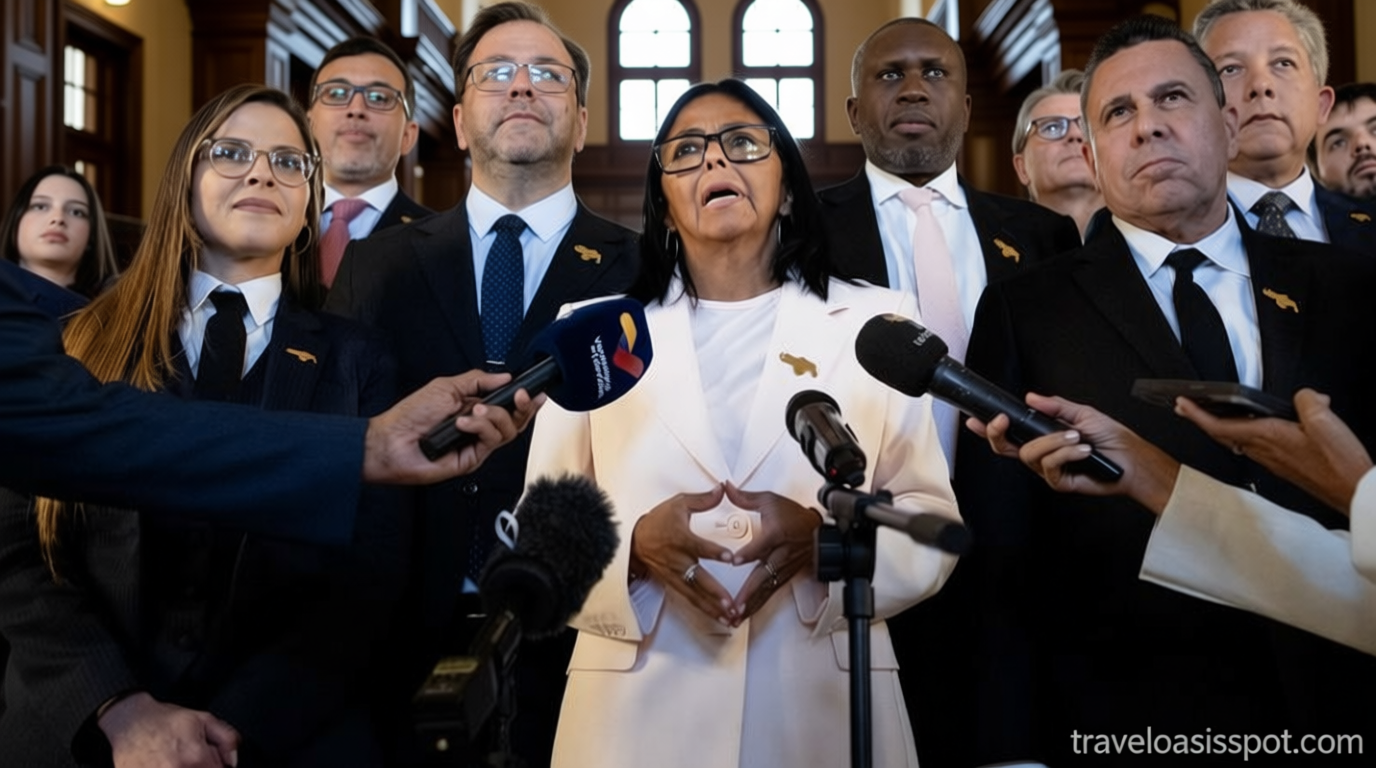
Venezuela’s Acting President Rejects Trump’s 51st State Remarks
Venezuela s acting president defends country – Venezuela’s acting president, Delcy Rodríguez, has defended her nation’s territorial claims and dismissed remarks by former U.S. president Donald Trump suggesting Venezuela could become the 51st state of America. The controversy emerged during the International Court of Justice’s final deliberations on a long-standing dispute between Venezuela and Guyana over the Essequibo region. Rodríguez emphasized Venezuela’s steadfast commitment to its sovereignty, countering Trump’s statement with assertive arguments that underline the country’s historical and legal rights to the contested land.
Trump’s Provocative Claim and the Court’s Response
During a televised interview with Fox News, Trump controversially proposed making Venezuela the 51st U.S. state, a statement that drew sharp rebukes from Venezuelan officials. The remark, posted by co-anchor John Roberts on social media, was quickly clarified by White House representatives, who admitted the comment was ambiguous. While the U.S. government did not explicitly endorse the idea, it highlighted the broader geopolitical tensions between the two nations. Rodríguez, however, remained unshaken, framing the statement as an attempt to undermine Venezuela’s territorial integrity.
The International Court of Justice played a central role in the dispute, with Venezuela and Guyana presenting conflicting arguments over the Essequibo region’s ownership. Venezuela’s claim traces back to the Spanish colonial period, while Guyana’s assertion is based on a 1899 arbitration decision. Despite this, the U.S. has been a key player in the conflict, with Trump’s remarks reigniting discussions about potential American influence in the region. The court’s ruling, expected to take several months, will determine the legal status of the territory and validate Venezuela’s position.
A Historic Dispute with Strategic Ramifications
The Essequibo region has been a point of contention for over a century, with Venezuela arguing that its claim was reinforced by the 1966 Geneva Agreement. This treaty, signed after the 1899 arbitration, was intended to ease tensions between the nations but has since been used to justify conflicting interpretations. Guyana, on the other hand, sees the region as vital to its economic development, particularly with recent oil discoveries that have heightened its strategic importance. The current legal battle highlights the complex interplay between historical treaties and modern geopolitical interests.
Rodríguez’s stance at the International Court of Justice underscored Venezuela’s determination to protect its territorial claims. She stressed that the Essequibo region is not just a geographical area but a symbol of Venezuela’s national identity. The acting president also pointed to the ongoing political instability in Guyana as a factor in the country’s decision to pursue a judicial resolution. While the U.S. has historically supported Guyana’s position, Trump’s remarks have introduced new layers of scrutiny to the case, prompting Venezuelans to reaffirm their resolve.
Recent Political Shifts and the 2018 Hearings
The 2018 ICJ hearings marked a pivotal moment in the dispute, with Guyana bypassing diplomatic negotiations to seek a judicial outcome. This decision was influenced by the discovery of significant oil reserves in the region, which Guyana views as a critical economic asset. Venezuela, however, maintained that the 1966 agreement was meant to foster cooperation, not serve as a legal basis for territorial division. The current legal process now faces the challenge of reconciling these historical claims with contemporary geopolitical realities.
Rodríguez’s appearance at the ICJ highlighted Venezuela’s strategic approach to the conflict. By focusing on the 1966 agreement, she positioned the dispute as a matter of international law rather than a purely political issue. The acting president also acknowledged the importance of diplomatic engagement, noting that Venezuela has consistently sought dialogue with Guyana. However, the U.S. role in the conflict has intensified, with Trump’s remarks casting doubt on the potential for immediate resolution. The outcome of the case could reshape the region’s political landscape and influence future relations between the countries involved.





