EU’s Leadership in Gaza Aid Under Scrutiny
Ursula von der Leyen – During a recent press conference in Cork, European Commission President Ursula von der Leyen defended the EU’s role in supporting Gaza, asserting that no other entity provides more assistance to the Palestinian population. The discussion arose after critics questioned the commission’s perceived hesitance in taking action against Israel, particularly regarding the expansion of settlements in the West Bank. Von der Leyen emphasized the EU’s commitment, stating that the bloc remains the primary source of aid for the region.
EU’s Humanitarian Efforts and Political Challenges
Von der Leyen highlighted the EU’s substantial contributions, including over 2.7 billion euros in humanitarian aid and budget support since October 23. She also noted the organization of 85 bridge flights to deliver essential supplies, totaling more than 5,600 tonnes, which she described as critical to the region’s needs. “No one does more than us,” she reiterated, aiming to clarify the EU’s proactive stance despite the questions raised.
“First of all, perhaps to set the record straight, we are the world’s largest provider of assistance to the Palestinian people, the largest. No one does more than us.”
While acknowledging the EU’s efforts, von der Leyen pointed out that the bloc’s actions on the Israel-Palestine issue remain stalled. She criticized the continued growth of Israeli settlements as “utterly unacceptable” and the violence used to enforce them as “abhorrent.” Despite this, she noted that the EU has been actively discussing the matter, though no consensus has emerged on the next steps.
The EU’s proposed measures, such as suspending trade preferences under the EU-Israel Association Agreement, have been on the table for 10 months. Von der Leyen stressed that this move would carry a “significant economic impact,” but it is still awaiting approval from member states through a qualified majority vote. “The ball is in the court of the member states,” she said, underscoring the political nature of the decision.
Irish Presidency and EU Priorities
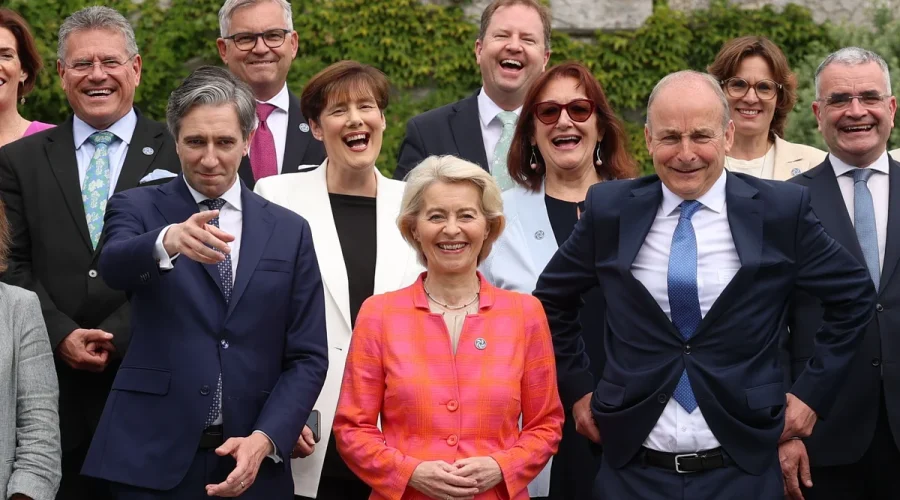
As Ireland began its six-month tenure as president of the Council of the EU, von der Leyen and the commission met with Irish officials in Cork. The visit coincided with Ireland’s focus on advancing key initiatives, including the EU-Israel Association Agreement and the development of a framework for sanctioning Israeli ministers. The discussions also touched on the Aughinish Alumina refinery, the multi-annual budget, and sub-sea cable projects.
Irish Prime Minister Micheál Martin, who hosted the meeting, pledged to bolster the EU’s role as a global leader. His address highlighted the country’s commitment to fostering peace in the Middle East and strengthening the bloc’s international influence. Von der Leyen and Martin were joined by other EU commissioners, who had arrived in Cork earlier that week.
“In his opening address, Mr Martin said that Ireland would work to ‘strengthen the European Union’s role as a principled global actor,’ including by pushing for peace in the Middle East.”
Technical Hurdles with the Entry-Exit System
During the press conference, von der Leyen addressed concerns about the Entry-Exit System (EES), which has led to delays at European ports and airports. She acknowledged that the system, launched in April, has created significant bottlenecks, with thousands of travelers facing long wait times. While the EES does not alter the legal framework for EU entry and exit, it increases transparency by tracking compliance with existing rules.
Despite the system’s rollout, von der Leyen admitted that “still quite a lot of work to do” remains to resolve technical challenges. The EU is collaborating with member states to improve the system, but progress has been slow. “There’s still quite a lot of work to do to have these technical issues solved together with the member states,” she said, emphasizing the need for continued coordination.
Social Media Regulation and Future Plans
Another topic raised during the conference was the potential introduction of a social media ban for young people. Von der Leyen expressed hope that an upcoming expert report, scheduled for July 13, would provide a “comprehensive concept about social media delay for different age groups.” The commission plans to use this report as a foundation for developing a legal proposal to regulate online platforms.
“It is not a question of when children or teenagers would have access to social media,” she said. “It is more a question of when ‘social media has access to our children and teenagers.’”
Von der Leyen’s comments reflect a growing EU concern about the impact of digital platforms on youth. While the proposal is still in its early stages, it signals the commission’s interest in addressing the issue of online influence. This initiative aligns with broader discussions on digital governance and child protection, which have gained momentum across the bloc.
Broader Context: Economic and Energy Developments
Outside the main focus on Gaza and the EES, the press conference also covered other topics. These included the anticipated rise in energy prices, with a 13% increase expected in July, and the steady nature of the October price cap. Additionally, Donald Trump’s £30 million income from UK golf resorts was noted as a financial figure that pales in comparison to cryptocurrency earnings, highlighting shifting economic trends.
Meanwhile, reports suggested that the EU could introduce a social media regulation framework as early as September, targeting the way platforms interact with young users. Von der Leyen’s remarks indicated that this measure is part of an evolving strategy to ensure digital spaces are safer and more accountable for minors. The proposal aims to balance access with protection, a challenge that has sparked debate among policymakers.
Political Dynamics and EU Unity
Von der Leyen’s responses underscored the complexities of EU decision-making. While she acknowledged the “a lot of activity” surrounding the Israel-Palestine issue, she stressed that achieving a unified approach requires time. “There is activity, and a lot of activity going on in the Council right now, no move forward with a solution or an agreement on how to proceed,” she said, pointing to the need for consensus among member states.
The discussion on sanctions against Israeli minister Itamar Ben-Gvir further illustrated the divide in EU policy. Although many states have proposed measures, a consensus has yet to form. Von der Leyen’s comments suggest that the commission is prepared to act but relies on member states to finalize the necessary political steps. This dynamic highlights the EU’s decentralized structure, where collective action depends on alignment among 27 nations.
As the EU continues to navigate its role in the Gaza crisis and internal challenges like the EES and social media regulation, von der Leyen’s emphasis on leadership and transparency reflects a broader vision of the bloc’s global responsibilities. Her statements, delivered in Cork during Ireland’s presidency, serve as a reminder of the EU’s multifaceted approach to both humanitarian and economic issues.
With the pressure to act mounting, the commission’s ability to balance immediate aid with long-term policy decisions will be critical. Von der Leyen’s defense of the EU’s efforts, coupled with her acknowledgment of ongoing challenges, paints a picture of an institution striving to maintain its position as a key player in international affairs, even in the face of internal and external pressures.