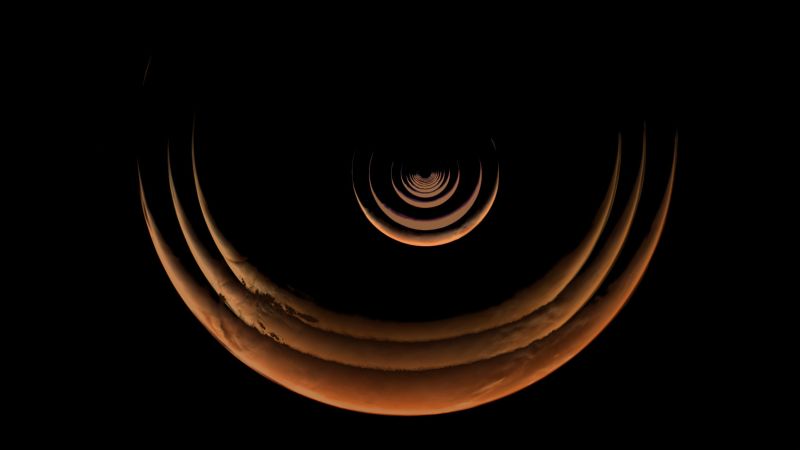
Asteroid mission captures rarely seen perspective of Mars during close flyby
A New Perspective on Mars
Asteroid mission captures rarely seen perspective – As NASA’s Psyche spacecraft continued its journey toward a unique metallic asteroid, it executed a calculated flyby of Mars, yielding an uncommon vantage point of the red planet. This maneuver, part of the mission’s broader strategy, allowed the probe to adjust its trajectory while conserving fuel. The spacecraft’s cameras recorded a series of images that provided scientists with a rare view of Mars from a high angle, offering insights into the planet’s surface features and atmospheric conditions.
The Psyche Mission’s Journey
Launched in October 2023, the Psyche mission aims to study Asteroid 16 Psyche, a peculiar space rock located in the outer asteroid belt between Mars and Jupiter. Unlike most asteroids, this one is believed to consist predominantly of metal, sparking speculation about its origins. Some researchers think it could be the exposed core of a protoplanet—similar to the inner layers of Earth, Mars, Mercury, and Venus—that once existed in the early solar system. To reach this target, the spacecraft will traverse a distance of 2.2 billion miles (3.6 billion kilometers), with an expected arrival in the summer of 2029.
The Mars flyby served as a critical mid-journey checkpoint. By leveraging the planet’s gravitational pull, mission planners aimed to optimize the spacecraft’s speed and realign its orbital path. This technique, known as a gravity assist, is commonly used in deep-space missions to reduce fuel consumption and refine trajectories. During the maneuver, Psyche approached Mars at a distance of just 2,864 miles (4,609 kilometers) from the planet’s surface, capturing high-resolution data that will aid in its eventual study of the asteroid.
Gravity Assist and Scientific Gains
The flyby’s significance extends beyond navigation. As Psyche passed by Mars, its cameras recorded a strikingly different view of the planet. Unlike the typical low-angle snapshots from Earth-orbiting satellites, these images showcased Mars as an illuminated crescent, highlighting its polar regions and surface textures. Don Han, the mission’s navigation lead at NASA’s Jet Propulsion Laboratory, noted the impact of the encounter. “Mars provided a 1,000 mph velocity boost and altered the spacecraft’s orbital orientation by roughly 1 degree relative to the Sun,” he explained. “This adjustment ensures we remain on track for our 2029 rendezvous with Asteroid 16 Psyche.”
The imaging team took full advantage of the opportunity to capture thousands of photographs, focusing on both the planet’s daytime and nighttime features. These included the south pole’s ice caps, dust storms sweeping across equatorial regions, and craters shaped by ancient meteor impacts. Jim Bell, the mission’s imager instrument lead at Arizona State University, emphasized the value of these images. “The thin crescent during approach and the nearly full Mars view after passing create ideal conditions for calibration and stunning visual documentation,” he said. “This is a chance to test our instruments under real-world conditions before arriving at the asteroid.”
Calibration and Future Missions
Calibrating the spacecraft’s scientific tools on Mars was essential for ensuring their accuracy when analyzing the asteroid’s composition. The metal surface of Psyche, which reflects light in unusual ways, presents a unique challenge for imaging technology. By observing Mars, scientists can fine-tune the cameras and spectrometers to capture precise data about the asteroid’s metallic structure. This process also helps validate the spacecraft’s ability to operate in the harsh conditions of space, where temperature fluctuations and radiation exposure could affect its performance.
The mission’s trajectory is designed to allow Psyche to enter an elliptical orbit around the asteroid once it arrives. This orbit will enable the spacecraft to map the asteroid’s surface in detail, scanning its metallic layers for clues about planetary formation. If the data confirms Psyche’s origin as a protoplanet core, it could revolutionize our understanding of how planets like Mars and Earth developed. The asteroid’s composition may reveal insights into the core’s mineral content, potentially shedding light on the early solar system’s dynamics.
Scientific Implications and Mission Objectives
Studying metallic asteroids like Psyche offers a window into the primordial building blocks of planets. Unlike rocky asteroids, which are composed of silicate materials, Psyche’s metal-rich surface suggests it may have formed from the densest materials in the solar system’s early stages. This hypothesis aligns with theories about planetary differentiation, where heavier elements sank to the center while lighter materials floated to the surface. If Psyche indeed represents a planetary core, its examination could provide unprecedented information about the internal structures of terrestrial planets.
The Mars flyby also highlighted the spacecraft’s capabilities. As it passed by, the cameras captured surface details that would otherwise be invisible from its primary mission path. These images, which include features like wind-driven dust patterns and crater formations, will be used to refine the imaging techniques planned for the asteroid. The mission’s success depends on the accuracy of these tools, as they will be vital for analyzing Psyche’s surface and determining its geological history.
While the primary goal remains the study of Asteroid 16 Psyche, the flyby underscored the interconnectedness of space exploration. By using Mars as a temporary observation platform, the mission not only refined its path but also contributed to planetary science. The images and data collected during this encounter will help scientists understand the red planet’s surface characteristics, potentially uncovering new information about its past climate and geology. For instance, the crescent view might reveal features related to Mars’ ancient oceans, which some researchers believe once covered large portions of the planet’s surface.
Psyche’s journey is a testament to the ingenuity of space missions. By combining solar-electric propulsion with gravitational assists, the spacecraft demonstrates how technology and celestial mechanics can work together to achieve distant objectives. The mission’s planners emphasized that this flyby was not a diversion but a necessary step to ensure the spacecraft’s long-term stability. As the probe continues its voyage, it carries with it the hopes of scientists eager to unlock the secrets of a metallic world.
Looking Ahead
With the Mars flyby successfully completed, the focus now shifts to the final leg of the mission. The spacecraft will enter an orbit around Asteroid 16 Psyche, where it will conduct detailed surveys of the space rock. These surveys will use advanced instruments to measure its magnetic field, analyze its mineral composition, and map its topography. The data gathered could provide critical evidence about the planet-forming processes that shaped the solar system billions of years ago.
The Psyche mission’s success hinges on its ability to overcome the challenges of deep-space exploration. The asteroid’s distance and unique composition require precise navigation and robust instrumentation. The Mars encounter, while a brief detour, served as a valuable test of these systems. Scientists are particularly interested in how the spacecraft’s cameras handle the contrast between the bright metallic asteroid and the darker Martian terrain. This experience will inform the design of future missions, ensuring they are equipped to study even the most enigmatic celestial bodies.
As the spacecraft approaches its destination, the anticipation builds. The images of Mars, while a secondary outcome of the mission, have already generated excitement among researchers. These photos not only serve as a calibration tool but also as a reminder of the beauty and complexity of our solar system. The Psyche mission, with its ambitious goals and strategic maneuvers, exemplifies the innovative spirit driving modern space exploration. By studying a metallic asteroid, scientists may uncover answers to some of the universe’s most profound questions about planetary formation and evolution.