
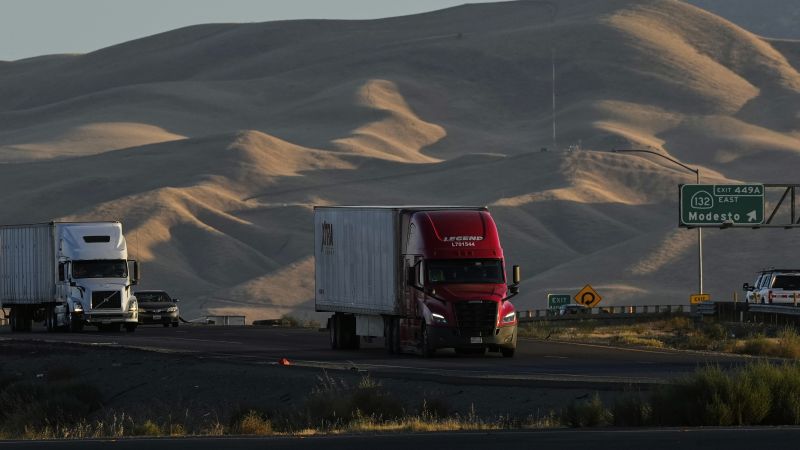
He was a truck driver for 20 years. With new Trump rules, he’s off the road
He was a truck driver for 20 – Luis Sanchez, a seasoned truck driver from near Fort Worth, Texas, has spent two decades hauling goods across the United States. From restaurant supplies to construction materials, his work has been a constant presence on America’s highways. Yet, despite his years of experience and a clean safety record, Sanchez now finds himself stranded. The Trump administration’s recent immigration policies have upended his career, revoking his commercial driver’s license (CDL) and leaving him without a way to earn a living. He’s not alone—thousands of noncitizen drivers have faced similar fates in the past year.
The New Rules and Their Consequences
The crackdown began after a series of fatal accidents involving truckers whose legal status was called into question. Officials cited these incidents as evidence that unqualified foreign drivers pose a threat to public safety. In February 2025, the administration introduced a rule limiting CDL renewals to drivers with specific visas, excluding many noncitizens who had previously held valid permits. This change forced states to reassess licenses, often downgrading them if their expiration dates conflicted with the holders’ work permits.
Sanchez, who had maintained a perfect safety record, renewed his license two years ago. By 2026, he was among those affected. “We don’t go home every day like normal work,” he said. “Sometimes we had to sacrifice family for the job we had.” His story reflects the broader impact of the policy, which has removed up to nearly 200,000 licenses from the road—about 5% of active CDL holders. The Federal Motor Carrier Safety Administration (FMCSA) defended the move, stating it targets “unqualified foreign drivers” who “pose a significant safety threat.”
A Dependence on the Trucking Industry
The United States relies heavily on its trucking sector, with commercial vehicles moving nearly 73% of the nation’s freight in 2024. This industry faces chronic labor shortages and high turnover rates, making it difficult to replace drivers quickly. Nearly one in six CDL holders is foreign-born, and communities like Punjabi Sikhs have long been integral to the workforce. Yet, the new rules have created uncertainty for these groups.
The Florida Turnpike crash in August 2025 highlighted the stakes. A Sikh driver, reportedly an undocumented immigrant, made an illegal U-turn, killing three people. Authorities later determined he had entered the country in 2018 without proper documentation. Two months later, another incident in California—linked to an asylum seeker—resulted in a pile-up that claimed three lives. These tragedies fueled the administration’s push for stricter licensing criteria.
Industry Reactions and Legal Challenges
While some argue the rules enhance safety, others criticize them as overly broad. The Department of Transportation’s audits revealed thousands of licenses with mismatched expiration dates compared to work permits. These discrepancies, often due to administrative errors, led to automatic revocations in several states. New York, for instance, resisted the move and is now suing for lost federal funding. Texas, where Sanchez resides, complied with the order, leaving him without a license.
Sanchez’s experience mirrors that of many others. He learned of his revoked license after watching a TikTok video shared by another noncitizen driver who described the same fate. “I checked my own permit,” Sanchez said. “And realized I had no choice but to stop driving.” The policy has created a ripple effect, disrupting supply chains and forcing companies to hire from a shrinking pool of qualified workers.
Testing the Safety Assumptions
Transportation Secretary Sean Duffy, following the Florida crash, emphasized the need for stricter oversight. “Licenses to operate a massive, 80,000-pound truck are being issued to dangerous foreign drivers—often times illegally,” he stated in a September 2025 statement. The administration’s actions included targeting “chameleon carriers,” fleets that use multiple registration numbers to bypass regulations. They also shut down hundreds of fake CDL mills, which allegedly sold licenses to drivers without proper documentation.
However, critics argue the measures have unfairly penalized individuals who were not at fault. Many noncitizen drivers, including DACA recipients and refugees, had met all legal requirements for years. Their licenses were suddenly invalidated based on a new interpretation of residency status. “It’s like a blanket policy,” said one industry advocate. “Drivers who were safe and compliant are now being labeled as threats.”
The Road Ahead
As the policy takes full effect, its long-term consequences remain unclear. Truckers who once relied on flexible work permits now face stricter residency rules, forcing some to leave the industry. This shift has raised concerns about the availability of drivers for critical goods like food and medical supplies. Meanwhile, states and advocacy groups continue to challenge the rules in court, arguing they disrupt the workforce and penalize drivers for administrative lapses.
Sanchez, now out of work, is part of a growing narrative about the human cost of immigration enforcement. His journey from a reliable driver to a displaced worker underscores the delicate balance between safety and fairness in the trucking industry. “I’ve driven for 20 years, and now I’m just a number in a policy,” he said. The question remains: Will these measures improve safety, or will they create a new crisis in the highways that connect the nation?





