
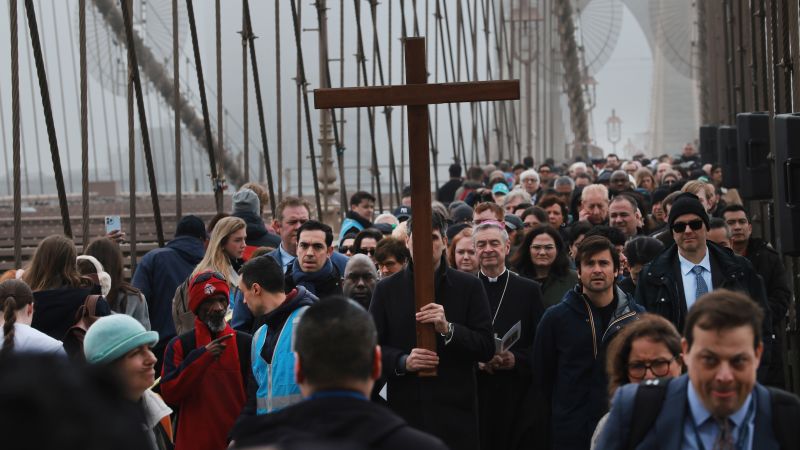
Religion is ‘back in fashion’ in America. Here’s why
A Church in Crisis and Rebirth
Religion is back in fashion in America – Rev. Fred Robinson, now senior pastor of Mt. Gilead Missionary Baptist Church in Atlanta, Georgia, recalls the moment he stepped into the once-faded sanctuary of his congregation. The building, situated in suburban Atlanta, had become a symbol of decline—its brick walls marred by sinkholes, its bathroom floors warped by decay, and its basement choked with mold. To enter, Robinson had to wear gloves and goggles, a precaution that underscored the dire state of the church’s infrastructure. At the time, the congregation numbered just nine members, with a meager $450 in savings, and was on the brink of closure. The pandemic had delivered a devastating blow, halting in-person worship and accelerating the exodus of members. With no staff or regular attendees to upkeep the building, the physical state of Mt. Gilead deteriorated rapidly.
Yet, where others saw despair, Robinson found hope. He sought out a congregation eager to evolve, one that could rebuild both its physical space and its spiritual approach. Four years later, the results are striking. Membership has surged, the message of the church has been reimagined, and the sanctuary has been fully renovated. The once-dilapidated basement, now a vibrant space, has become a testament to the community’s renewed energy. “New people came. People started coming back,” Robinson explains. “They embraced the vision of rebuilding the physical sanctuary and doing theology differently.” His story is not unique; it reflects a broader trend across American religious communities.
A National Prayer Event and a Shifting Landscape
On Sunday, as the Trump administration prepares to mark America’s 250th anniversary, it will host a symbolic event to reignite the nation’s faith. Titled “Rededicate 250: A National Jubilee of Prayer, Praise & Thanksgiving,” the gathering on the National Mall aims to inspire collective spiritual renewal. But the event may be more than a political gesture. It aligns with a growing movement that suggests religion is no longer in retreat. A recent study from the Hartford Institute for Religion Research reveals that the resurgence of faith is happening in unexpected places, far from the political spotlight in Washington.
According to the survey, the number of people attending in-person worship services in the U.S. has seen a remarkable uptick. For the first time in 25 years, the median attendance has climbed from 45 in 2021 to 70 today. However, these numbers represent only part of the story. Many congregations, particularly those in smaller communities, have experienced deeper transformations. The study highlights a shift in engagement, with worshippers not only attending more frequently but also contributing more financially, volunteering more actively, and embracing innovative practices within their faith groups.
Conservative Congregations Lead the Charge
While the overall trend is positive, the revival has not been uniform. Theologically conservative religious groups, especially those in Republican-leaning areas, have shown the most significant growth. Researchers attribute this to the cultural resonance of leaders like former President Donald Trump and late conservative speaker Charlie Kirk, who have become icons for many white evangelical Christians. Their influence has helped consolidate faith in communities where traditional values remain central to identity and purpose.
The pandemic played a pivotal role in this resurgence. As lockdowns forced many congregations to go virtual, some evangelical churches opted to remain open, drawing members who craved the intimacy of in-person worship. Rev. Scott Thumma, director of the Hartford Institute for Religion Research, notes that these churches were “less cautious” in their approach, often opening their doors earlier than others. This willingness to adapt, he says, allowed them to attract new followers and deepen existing connections. “A congregation that was less cautious and more willing to stay open or open quicker—those congregations grew faster than the congregations that were playing it safe and were listening to the CDC and stayed closed long,” Thumma explains.
Theology, Health, and a New Era of Faith
The study also reveals that worshippers are reporting improved physical and mental health, a finding that surprised researchers. The survey, which included leaders from 7,453 congregations across multiple Christian denominations, as well as Jewish, Muslim, and Hindu communities, suggests that spiritual activity is tied to broader well-being. “The biggest surprise to me was that median worship size had increased,” Thumma says. “In my entire career… the size of congregations, the membership numbers, worship attendance—everything has trended downward for the last 40 years. To have this not only rebound from pandemic lows, but actually to go above where congregations were in 2020 before the pandemic, was really surprising to me.”
Despite this momentum, challenges remain. Nearly half of the surveyed congregations report declining attendance, a reminder that the revival is not yet universal. Some communities, particularly those in urban areas or among younger generations, have struggled to sustain their momentum. Yet, for those that have found renewed purpose, the pandemic’s disruption has acted as a catalyst. The crisis forced congregations to reevaluate their priorities, leading to creative solutions that have strengthened their foundations.
From Despair to Dedication
Robinson’s journey from a struggling church to a thriving community mirrors the broader transformation in American religion. His experience highlights how adversity can spark innovation. By focusing on physical restoration and redefining their theological mission, Mt. Gilead has become a beacon of resilience. “We had to start over,” he says. “But the people here were ready to rebuild.” This mindset of renewal is shared by many congregations that have embraced the challenge of adapting to a post-pandemic world.
As the nation celebrates its 250th anniversary, the revival of religious life offers a hopeful counterpoint to the uncertainties of recent years. While the Trump administration’s prayer gathering may symbolize a political push for spiritual unity, the real story lies in the grassroots efforts of communities across the country. These groups, once on the verge of closure, have not only survived but thrived, proving that faith can be a powerful force for change. Their success suggests a deeper shift in American society—one where religion is once again becoming a central part of cultural and personal identity.
A Future of Faith and Adaptation
The Hartford Institute’s findings underscore a pivotal moment in the history of American religious life. The rebound from pandemic-induced decline is not just a return to normalcy; it’s a renaissance that has redefined how faith communities operate. As congregations like Mt. Gilead demonstrate, the key to survival lies in flexibility, vision, and the ability to connect with people in meaningful ways. The study’s authors argue that this renewed vitality is a sign that religion is “back in fashion,” not just in terms of numbers, but in its relevance and influence.
While the road to full recovery may still be long, the data is clear. Faith is not only surviving—it’s evolving. The challenges faced by many congregations have led to a reexamination of their purpose, their practices, and their outreach. This period of transformation, fueled by both crisis and opportunity, marks a new chapter in the American religious landscape. As the nation looks ahead, the question remains: will this resurgence continue, or will it face new obstacles in the years to come?
“The biggest surprise to me was that median worship size had increased,” Thumma tells CNN. “In my entire career… the size of congregations, the membership numbers, worship attendance—everything has trended downward for the last 40 years. To have this not only rebound from pandemic lows, but actually to go above where congregations were in 2020 before the pandemic, was really surprising to me.”
Their story, and the stories of countless other congregations, suggests that the future of American religion is not one of decline, but of reinvention. With renewed commitment and creative leadership, faith communities are finding ways to thrive in an ever-changing world. The pandemic may have disrupted traditional practices, but it also ignited a movement that has redefined the role of religion in American life. As the country moves forward, the spirit of revival will likely shape the next era of faith and faith-based influence.





