
Unveiling the Deep: Over 1,100 Ocean Species Revealed in Groundbreaking Discovery
From ghost sharks to death ball – In the uncharted depths of the ocean, a peculiar worm, a mysterious “ghost shark,” and a carnivorous “death ball” sponge have been identified as just a few of the 1,121 species previously unknown to science. These findings, unveiled by the Ocean Census, a global initiative to catalog marine life, were announced on Tuesday during a press release highlighting the organization’s latest progress. Comprising over 1,000 researchers from 85 nations, the Ocean Census, spearheaded by Japan’s Nippon Foundation and the UK-based Nekton ocean exploration institute, has marked a 54% surge in annual species identifications since its inception three years ago.
A World of Wonders Beneath the Waves
The deep sea, long regarded as an enigmatic frontier, continues to surprise scientists with its diversity. What was once thought to be a barren expanse, now revealed to be teeming with life, hosts ecosystems that defy expectations. The recent discoveries underscore the ocean’s capacity to conceal organisms with unique adaptations, some of which challenge traditional understanding of survival in extreme conditions. From bioluminescent creatures to organisms that thrive in crushing pressures, the marine realm remains a treasure trove of biological innovation.
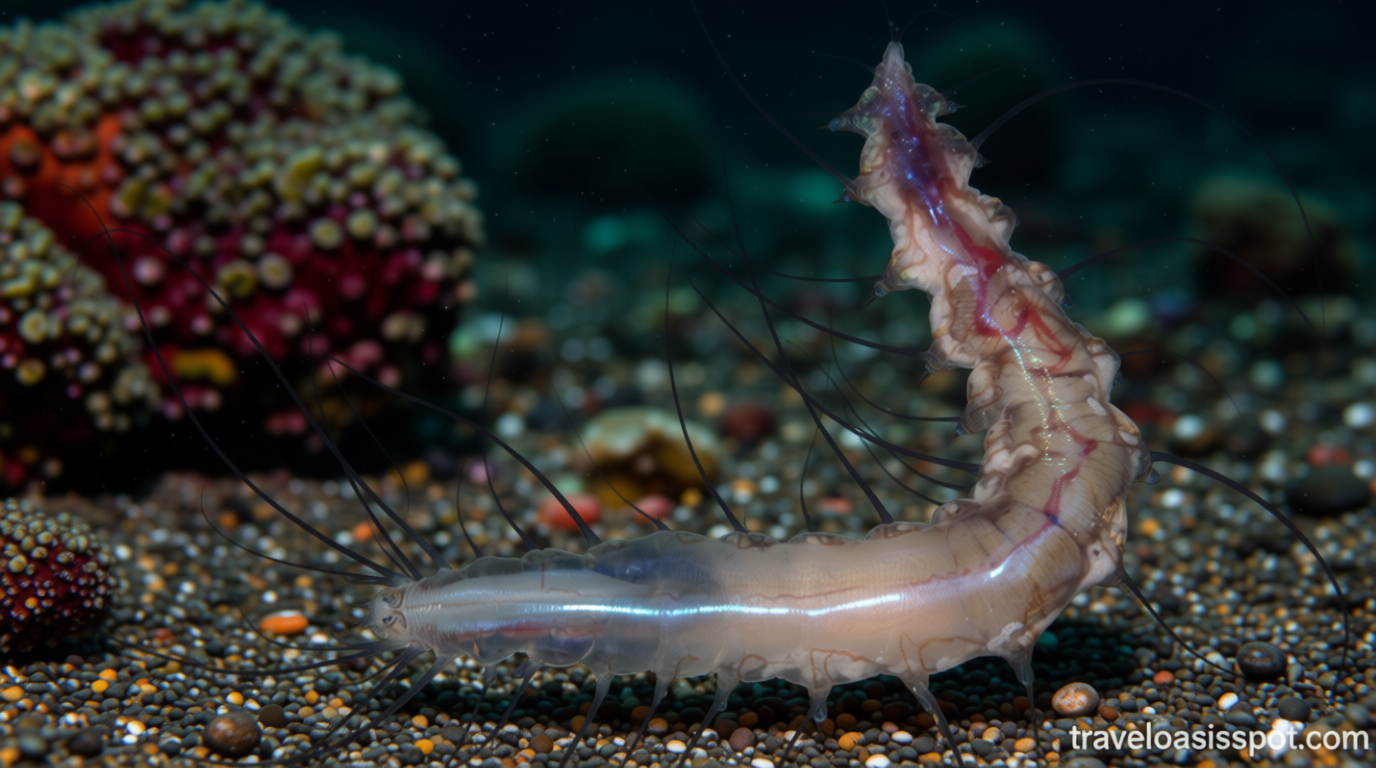
Among the most intriguing finds is a bristle polychaete worm that resides within a “glass castle,” a term used to describe the intricate, translucent skeletons of certain deep-sea sponges. This symbiotic relationship between the worm and its host highlights the complex interdependencies that define deep-sea ecosystems. The worm, protected by the sponge’s silica-based structure, aids in cleaning its environment, while the sponge benefits from the worm’s presence. Such interactions are crucial for the survival of both species in the harsh, lightless depths.
Challenges in the Depths: Climate and Human Impact
Despite these revelations, marine life faces mounting threats. Rising ocean temperatures, driven by climate change, are altering habitats and disrupting delicate ecological balances. Concurrently, human activities such as industrial and agricultural pollution are introducing toxins into the water, further endangering biodiversity. The growing interest in deep-sea mining for rare minerals adds another layer of risk, as it could lead to habitat destruction and the loss of species before they are even documented.
“The ocean is one of the last great frontiers for exploration, yet its species are increasingly vulnerable,” said Michelle Taylor, the Ocean Census’s lead scientist. “We’re in a race against time to understand and protect what lies beneath the surface before it’s too late.” Her words echo the urgency felt by researchers who navigate the challenges of documenting life in the abyss. The discovery of these species not only expands our knowledge of marine biodiversity but also emphasizes the need for immediate conservation measures.
Expeditions and Discoveries: A Year of Exploration
The Ocean Census team conducted 13 expeditions across some of the least explored regions of the world’s oceans. These missions, often spanning thousands of feet below the surface, required advanced technology and collaborative efforts to uncover hidden life. In the waters off Japan, scientists identified a new species of polychaete worm nestled within a glass sponge, a structure resembling a crystalline fortress. In Australia, a “ghost shark” chimaera was found at depths exceeding 2,700 feet, a discovery that sheds light on ancient evolutionary lineages. Meanwhile, in the Timor-Leste region, researchers cataloged a tiny ribbon worm adorned with bright orange stripes, a visual signal of its toxic capabilities.
Each of these species adds a new chapter to the story of marine life. The chimaera, a distant relative of sharks and rays, diverged from its ancestors nearly 400 million years ago, offering insights into prehistoric evolution. The ribbon worm’s vibrant coloration suggests a defense mechanism, as its secretions have been studied for potential applications in treating neurological disorders like Alzheimer’s and schizophrenia. The “death ball” sponge, found in the North Trench of the South Sandwich Islands, exemplifies the ocean’s hidden predators. Its microscopic velcro-like hooks trap unsuspecting prey, demonstrating an evolutionary marvel in the deep-sea food chain.
Speeding Up Discovery: New Scientific Recognition
To accelerate the pace of identification, the Ocean Census has introduced a new classification: “discovered” as a preliminary scientific status. This allows researchers to log species into an open-access database immediately upon validation, making them available to the global scientific community and policymakers. “This change streamlines the process, ensuring species are visible and actionable from the start,” explained a spokesperson for the Ocean Census. “It’s a vital step in bridging the gap between discovery and conservation.”
However, the process of formally describing a species remains critical. Tammy Horton, a research scientist at the UK’s National Oceanography Centre, noted that while some discoveries may later be reclassified, this is not a frequent occurrence. “The formal description process is essential,” she told CNN. “It verifies the uniqueness of a species and establishes its official record, which is necessary for both scientific recognition and legal protection.” Without this step, a species may lack the formal identity required for conservation efforts, leaving it vulnerable to exploitation or extinction.
A Call to Action: Protecting the Ocean’s Future
The Ocean Census aims to use these findings as a catalyst for action, advocating for increased investment in marine research. The organization highlights the immense ecological, scientific, and economic value of the ocean, urging governments and industries to prioritize its preservation. “Every year, scientists uncover new species, but without dedicated resources, we risk losing them before they can be studied,” Horton emphasized. Her remarks underscore the need for sustained funding and international cooperation to safeguard these discoveries.
While the current list of 1,121 species is impressive, the process of confirming their novelty could take years. On average, it takes 13.5 years between a species’ initial discovery and its formal classification in scientific literature. This delay underscores the importance of the Ocean Census’s initiative to streamline recognition. By making findings accessible in real time, the project hopes to galvanize efforts to document and protect the ocean’s biodiversity before it’s too late.
As the world grapples with environmental challenges, these discoveries serve as a reminder of the ocean’s resilience and the untapped potential it holds. From the labyrinthine structures of glass sponges to the silent hunters of the deep, each new species offers a glimpse into the planet’s hidden ecosystems. The Ocean Census’s work is not just about counting life—it’s about ensuring that the ocean’s secrets are shared, understood, and preserved for future generations. With continued exploration and investment, the hope is that these findings will inspire a global commitment to protecting the vast, mysterious, and vital world beneath the waves.





